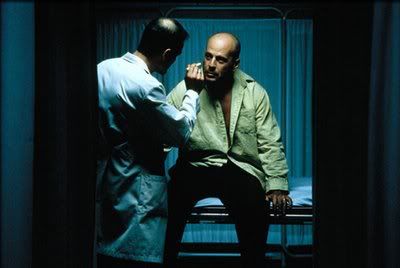
Auteur Criticism: Eyes Wide Shut and Stanley Kubrick
When it comes to the auteur theory, this is a debate over whether it is possible for one person to be the “author” of a film, or not, seeing that it is argued that film is more entertainment than art. The people who would argue this have obviously not seen the films of Alfred Hitchcock, Woody Allen, Orson Welles or Stanley Kubrick. An auteur is defined as “a filmmaker whose individual style and complete control over all elements of production give a film its personal and unique stamp” (dictionary.com). This definition couldn’t be applied more to anyone than that of Stanley Kubrick. He has was one of the most respectable directors in cinematic history, yet only directed 13 feature films over the span of a half-century. Each of his films, with the exception of his first two, were adapted from novels; yet Stanley Kubrick left his mark on each of those films. He was more than just the films’ director; he also acted as the producer, writer, and even sometimes the cinematographer and editor. Kubrick loved to challenge himself, his crew and cast, by being vigorous through pre-production, production and post-production.
His films cover a vast array of different topics, yet they are all uniquely the production of one cinema’s most visionary directors. Each film was unlike the one that came before it, and also the one that came after; Kubrick was constantly switching genres, never making the same type of movie twice. Paths of Glory, his first feature film, was an anti-war movie; Lolita, a love-story of sorts that was more concerned about lust and obsession; Dr. Stangelove, or How I Learned to Stop Worrying and Love the Bomb, a sardonic, satirical black-comedy about the Cold War; 2001: A Space Odyssey, a philosophical science fiction film about artificial intelligence and evolution; A Clockwork Orange, a social-study of teen violence in the world; Barry Lyndon, a period piece of one man’s life journey; The Shining, a horror film about the destruction of an all-American family living in isolation from society; Full Metal Jacket, another war movie, but was more concerned with the dehumanization of American soldiers during Vietnam; and lastly, Eyes Wide Shut, Kubrick’s meditation on fidelity, sex and death. These films seem to have nothing in common, but when watching them, one can see an artist at work. Many Kubrick films have to do with existential problems and society's effect/influence on the individual, the dehumanization of the individual, and the problem of differing dream from reality as well as recurring cinematic motifs, thus making Stanley Kubrick an auteur.
Kubrick is infamous for being very exacting with his actors, as noted in The Complete Kubrick:
Kubrick’s customary high take ratio – rumor had it he shot ninety-five different versions of Cruise walking through a door [in Eyes Wide Shut] – suited several other actors too. “I loved the fact that you were able to work a scene again and again,” Alan Cumming told Premier magazine, adding that, because the sound technician kept track of the slate numbers silently, “you didn’t go, ‘Oh, take 48, my God, this is terrible. You weren’t bored, because every take was different”. (Hughes, 247).
Stanley Kubrick’s films are more concerned with the study of the characters than the plot alone. His films play out as if a microscope were put up to the innate-human nature of his characters; his films show us the inner-workings, and sometimes, the dark side of people; it’s very hard to watch a Kubrick film and find yourself liking or relating to the main character(s). Yet Kubrick is well known for getting some of the best performances out of many accepted actors and actresses. His use of multiple takes, leading to lots of stress and anxiety in the actors, is what can be attributed to the very strongly emotional performances seen in his films such as Shelley Duvall and Jack Nicholson’s roles in The Shining or Tom Cruise and Nicole Kidman in Eyes Wide Shut.
Throughout Eyes Wide Shut’s extended shooting schedule, the usual rumors circulated: Kubrick was putting his two stars through an infinity of retaken scenes and script additions. If true, it looks worth the pains taken and given. Their performances come from mind as well as gut. Kubrick has wrenched Cruise and Kidman away from the placenta of their customary starring roles, making them seem to think for themselves and feel grief, guilt, shame and jealousy, too. (Walker, Taylor, Ruchti, 356)
Kubrick’s ability to get the most honest, powerful emotions out of his actors could be ascribed to the stressful environment he would create with his re-takes of shots, and even due to the fact that he read plenty about psychology and applied it to his directing methods.
Setting
Kubrick’s films all take place in different times and places, and obviously, in different genres of film. Yet one thing that can be said of his films is that each one contains a pivotal scene that takes place inside of a bathroom. This is the imagery Kubrick liked to use to show the audience that we are really looking into these characters’ lives more than the average film would. Each of Kubrick’s films showed us that we are not passive viewers of these characters’ lives, but more of active “voyeurs” of sorts. The bathroom, of course, is the most personal and secluded room a person can be in. Yet Kubrick (think of what Hitchcock did with Psycho), invites us into these private lives in the most private place a person can be, with an unblinking eye. In Eye’s Wide Shut, location is crucial to the imagery and motifs Kubrick is presenting. From the very first shots of the film, we are invited into Bill and Alice Harford’s (Tom Cruise and Nicole Kidman) private life. We are introduced to Alice, wife of Bill, as she has her back to the camera and her dress slips off of her body, then the screen cuts to black. Following that is the married couple getting ready in the bathroom together, with Bill at the mirror and Alice using the toilet.
Bathrooms and their ceramic conveniences occupy a central and ominous place in Kubrick interiors: the scene where Jack Nicholson’s Torrance encounters the messenger from his past life and foresees his fate in The Shining; or the site where Vincent D’Onofrio’s demented Marine in Full Metal Jacket blows his brains out seated on the toilet. (Walker, Taylor, Ruchti, 352-53)
Yet the most important use of the bathroom in Eyes Wide Shut is when Bill is at the Christmas party his friend Victor Ziegler (Sydney Pollack) throws. After Bill is nearly seduced by two attractive young women, he is summoned to Victor’s bathroom to resuscitate a young, naked woman who has overdosed on drugs. It is implied that Victor was having some sort of sexual encounter with this woman, therefore cheating on his wife. This scene is so significant because it is introducing Bill to the extra-marital world for the first time which leads to the argument with his wife and, ultimately, his journey to the orgy.
Another important thematic motif is the use of Christmas to signify the “dream state” Bill finds himself in. As with other Kubrick films (2001: A Space Odyssey, The Shining, A Clockwork Orange), there is the contrast between reality and dream states present throughout many scenes in this film. Christmas trees and lights are nearly ubiquitous throughout the film, present in nearly every scene starting with the Christmas party. “Christmas trees appear in almost every scene: in the couple’s living room, in the ballroom at Ziegler’s apartment, at the Sonata Café, even in the prostitute’s tiny apartment…Each appearance of a Christmas tree leads to a new phase of the doctor’s alienation.” (Helmetag, 277). One of the first shots of this Christmas party is that of the dance floor, shot at a relatively high-angle overlooking the dance floor, which is illuminated by chandeliers and (mostly) Christmas lights. “These ‘rich and famous’ guests dancing with the stars to easy-listening music might soon be enveloped into some time warp like that in The Shining, doomed to repeat their pleasurable, purposeless distractions to time without end.” (Walker, Taylor, Ruchti, 350) Yet even with the dreamlike use of Christmas lights in the party scene, Christmas lights are also present in nearly every single interior shot throughout Eyes Wide Shut. It is not until the end of the film, after Bill meets with Victor to discuss the last 24 hours of his dream-like walkabout the city and the events that unfolded after attending the orgy, that the Christmas lights are most important. “His nocturnal wanderings come to an end, and Kubrick shows us Bill arriving home. As Bill enters his home, he turns off the Christmas lights that have been so prominently featured throughout the film, as if to signal that the fantasy is over. It is time for Bill to [finally] face his wife.” (Hoffman, 77).
Structure
Seeing that Stanley Kubrick started out as a photojournalist, his movies are highly visual, allowing the images to speak louder than words. He constantly utilizes both elaborate moving-camera shots (mostly with the use of steadicam) and also very symmetrical compositions. “One of Kubrick’s formal trademarks is the use of symmetry and perspective in his compositions, which usually communicate a sense of uncontrollable fate.” (Mather, 209) These compositions are customary in Kubrick’s films: from the interiors of the barracks in Full Metal Jacket to the hallways of the Overlook Hotel in The Shining. Kubrick uses symmetry in his compositions most sparingly in Eyes Wide Shut, unless when needed to express the situation of providence and uncertainty. The famous “hallway shot” Kubrick has in his movies is when he combines both his use of the moving camera and that of a perfectly symmetrical composition of the hallway, it surrounds the character on all sides, creating a frame within a frame. This hallway shot is used many times in Eyes Wide Shut as the camera follows Bill Harford on his journey through the city by night, coming across strange people and even stranger situations, in search of some sort of answer to why his wife felt lustful towards another man. Every time Kubrick uses his hallway shot, we are watching Bill travel though a location that is foreign to him; it surrounds him, overtaking him in size and importance. Kubrick loved to use this shot in his films to show the contrast between disorder and order. His characters are always going through an internal struggle, and must fight against outside influences from their environment, and Kubrick used the frame within a frame shot of hallways to show this distraught character traveling through this orderly external world to find their own purpose at the end.
Kubrick’s use of color in his films is indicative of not only mood but also theme. Of all the Kubrick films done in color (2001: A Space Odyssey, A Clockwork Orange, Barry Lyndon, The Shining, Full Metal Jacket) Eyes Wide Shut is the most vivid in its color usage. Two main primary colors are ubiquitous throughout the film; red and blue. Throughout the film, a blue gelled light is used to signify the ambient moonlight. Seeing that nearly the entire film takes place at night, this dramatic blue is in virtually every scene. Yet this isn’t an “ordinary” artificial moonlight color seen in most films, it is a very bold and flamboyant blue. The reason for this is that the entire movie takes place in a dreamlike state for Bill Harford. After Bill and Alice “awake” from their dream is when this blue light isn’t seen anymore. This is also similar to the blue used in the bathroom scene in Full Metal Jacket, which also takes place at night, where Private Pyle kills himself, but not before saying “ I am…in a world of shit”. Furthermore, there is one color that cannot unnoticed in any of his films; the color red. He constantly uses red for its association with danger or harm. For example, take 2001: A Space Odyssey and its many uses of the color red. “White, black and red are its predominant hues: the black of space, the white of the spacecraft in it, the red glow bathing the crew inside the craft at moments of tension, peril, or disaster. (Walker, Taylor, Ruchti, 224). Or the red elevator doors and the dark red blood that spills from them in The Shining. But it is the use of red in Eyes Wide Shut that is most palpable. Red is used in every scene that involves Bill’s journey into the “underworld” of debauchery and promiscuity. Such as the doors of the prostitutes house Bill is invited into, the walls and stage curtain at the Sonata Café that Bill finds his old friend Nick, playing piano in (which is how he gets information about the orgy). Or the orgy scenes, where red is most evident, from the color of the carpets to the masked leader of the orgy, who is draped in a red cape. “Kubrick ballasts the architectural flamboyance by rigorously formal pattering of the figures in it, while a palate reduced to stark crimsons and livid purples signals the danger of trespassing on forbidden territory.” (Walker, Taylor, Ructhi, 230).
“The Glare”
Following with the theme of the dark side of human nature and the dehumanization of characters, Kubrick uses his most iconic shot which has been dubbed “the glare”.
It is the glare shot which is a common shot in Kubrick films which tend to show a character's emotional meltdown by showing a close up of the actor with their head tilted down slightly and their eyes looking up straight into the camera. In the Shining, the glare shot occurs when Jack is staring out a window and viewing a snow covered ground. The camera slowly zooms in on Jack who has demented look on his face. That one shot says it all without one word of dialog. Full Metal Jacket is great depiction of dehumanization […] Once again in Full Metal Jacket, the glare shot is used. This time it is in a bathroom where Private Pyle is sitting on a toilet with an M16 in his hands. The glare shot shows just how much Private Pyle has changed since the beginning of the movie. (associatedcontent.com)
The use of “the glare” in Eyes Wide Shut cannot go unnoticed, as with the aforementioned films. Although the use of Kubrick’s glare isn’t as conspicuous and diabolic as it is in previous Kubrick films, it still plays an important role in Eyes Wide Shut. One such use of “the glare” is when Bill Harford is riding inside of a taxi cab on a number of occasions. The first time is when he leaves the apartment after his wife’s confession of feeling licentious towards another man and takes a taxi cab to visit a deceased patient of his. During this cab ride, Bill is framed in a mid-close up with chin tilted downwards, but eyes upward looking toward the camera; this is Kubrick’s first use of “the glare”. In this scene, Bill’s glare is “focused” on a scene he has concocted in his imagination of his wife philandering with the sailor she mentioned earlier that night. “Kubrick adroitly makes use of genre expectations and cinematographic history to make an aesthetic statement on love and Bill's assumptions of love […] Kubrick portrays Dr William Harford's imaginings of his wife in a sexual encounter with a navy officer with the aesthetic of a mainstream pornographic film.” (Frey, 41). This pornographic image Kubrick is showing us is seemingly from Bill Harford’s subjective point-of-view. The juxtaposition of this image and “the glare” shot is what Kubrick is using to show us the state of mind Bill is in. He is beginning to question his wife’s faithfulness and also marriage in general. This stems from the previous scene, during which Bill and Alice have an argument over marriage and fidelity; Alice asks Bill if he wanted to sleep with the two women she saw him talking to earlier at the party and:
He adds that he does not desire other women because, as he tells Alice, ‘we are married and because I would never lie to you or hurt you’. Unfortunately, Bill’s claim only fuels his wife’s anger, because Alice interprets it to mean that Bill’s only reason for not sleeping with the models is ‘out of consideration’ for her, not because he does not desire them. (Hoffman, 63).
As with other Kubrick movies, Eyes Wide Shut is more than just about a struggling relationship, it is also about the challenging of institutions, in this case, the institution of marriage. The “institution” vs. the individual is present in nearly every Kubrick movie: The institution of family in The Shining, the individual vs. society in A Clockwork Orange, the soldier vs. the military in Full Metal Jacket. The one thing that links all these films together is the use of “the glare” to show the degradation of the individual due to the conflicts with the establishment they find themselves apart of. As with Full Metal Jacket’s treatment of the soldier as being nothing more than a mere member of the overall structure of the military, Kubrick treats Bill Harford’s assumptions of marriage in a similar light:
His eyes are indeed wide and shut at the same time, and the film is about, precisely, the relation of voyeurism to obliviousness in the construction of bourgeois heterosexuality. Kubrick’s attention to the structure of institutions may be seen to be in abeyance, then, only because it has been turned to that of an institution so prevalent that it might not even be recognized as one. It is as if the theme has become submerged, newly unconscious—distilled as the most fundamental and durable assumptions typically are. (Morrison, 39).
Stanley Kubrick was one of the least prolific yet one of the most respected filmmakers of his generation. With his career spanning over 40 years and having made 13 films, it is hard not to call him an auteur when looking at his method of use with his actors, motifs and thematic elements, color usage, camera movement and signature shots as a means of direct speech to the audience. After Kubrick’s death, Steven Spielberg was interview for the Eyes Wide Shut DVD, and he had this to say of Kubrick’s films: “Kubrick films tend to grow on you, you have to see them more than once. The wild thing is… I defier maybe one Kubrick film that you can turn off when you start it; it’s impossible. He’s got this fail-safe button or something, it’s impossible to turn off a Kubrick film.” (Eyes Wide Shut) This is the result of a great film artist, the auteur: Stanley Kubrick